|
||
31. Cloudy Taenite-rimmed Kamacite |
| Listing of Structures |
| Back...Next |
| Meteorite, Grant - IIIAB Iron. |
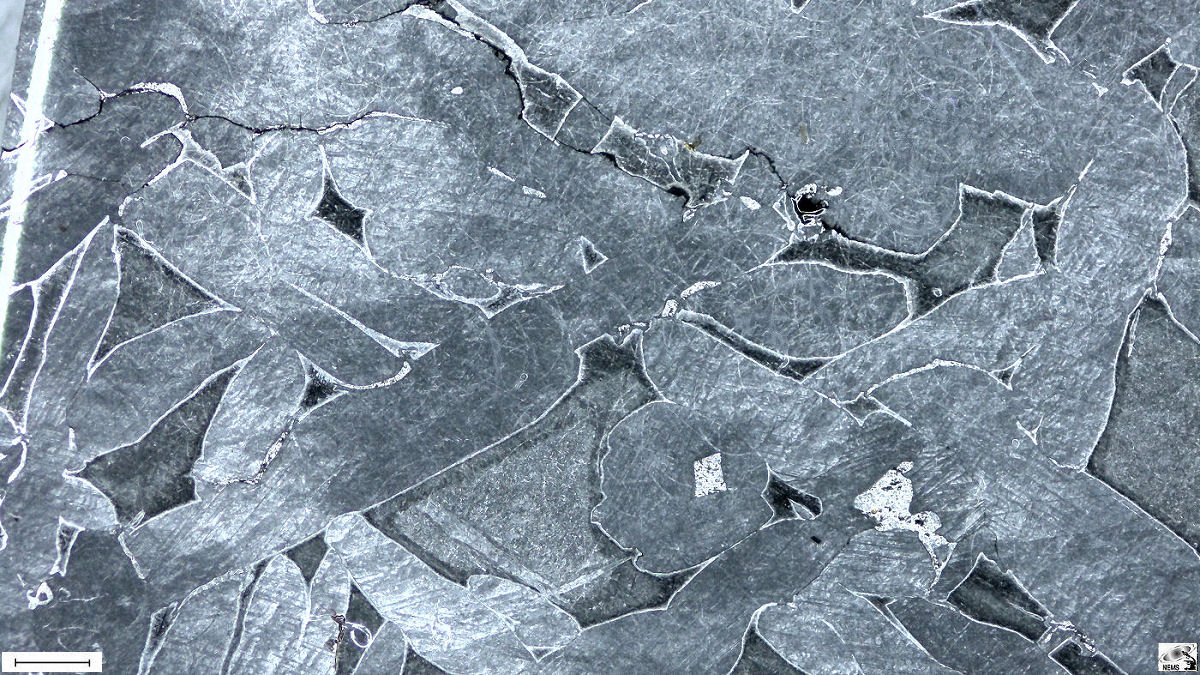
| Figure 1. Cloudy taenite-rimmed plessite and kamacite in the Grant iron meteorite (IIIAB group). Scale bar=1.2 mm. |
| Meteorite, Grant, IIIAB Iron |
| Cloudy Taenite Cloudy taenite is a high-nickel secondary microstructure commonly observed in iron meteorites, particularly within plessitic fields and along interfaces with kamacite. It consists of a submicroscopic, fine-scale intergrowth of taenite and an ordered Ni-rich phase, most commonly tetrataenite γ Fe/Ni with approximately 49–57 at.% Ni). This intergrowth arises during prolonged slow cooling (typically at rates of 1–100 °C per million years) through diffusional processes and ordering reactions below ~320–400 °C. The resulting optical “cloudiness” or mottled appearance under reflected light microscopy stems from the fine dispersion of these phases, which scatters light differently than homogeneous taenite. Bulk nickel contents in cloudy taenite regions typically range from ~30–45 wt% Ni. Cloudy taenite forms as a late-stage, low-temperature feature after the establishment of primary Widmanstätten patterns and plessite development. It records the final stages of Fe-Ni equilibration and the onset of long-range atomic ordering in taenite, providing valuable constraints on the metallographic cooling history of the parent body. Taenite Rims Taenite rims—often enriched in tetrataenite—are high-Ni zones that develop at the margins of kamacite lamellae or surrounding plessitic fields. These rims form through nickel diffusion and partitioning during cooling as the two-phase (kamacite + taenite) field is traversed. Nickel diffuses from the interior of taenite grains toward the interfaces with growing kamacite, producing steep compositional gradients (M-shaped Ni profiles) and localized enrichment at the boundaries. In many cases, the outermost rim consists of ordered tetrataenite, which appears bright and optically anisotropic in polished sections. In the Grant meteorite (a medium octahedrite, IIIAB), these features are well developed, with prominent cloudy taenite and tetrataenite rims encircling kamacite and plessite, illustrating the complex subsolidus evolution of IIIAB irons. Significance in Meteorite Petrology Cloudy taenite and associated taenite rims are diagnostic secondary structures that complement primary features such as the Widmanstätten pattern. Their development is highly sensitive to cooling rate, phosphorus content, and shock history. Quantitative analysis of Ni gradients and tetrataenite formation via electron probe microanalysis (EPMA) or transmission electron microscopy (TEM) allows estimation of cooling rates through the critical low-temperature regime, offering insights into the thermal insulation and size of the parent asteroid core. In IIIAB irons like Grant, these microstructures support models of fractional crystallization of a large metallic core followed by slow cooling in a relatively intact body. References • Buchwald, V. F. (1975). Handbook of Iron Meteorites. University of California Press. (Classic descriptions of cloudy taenite and taenite rims.) • Reviews on Fe-Ni phase equilibria, tetrataenite ordering, and cooling-rate studies in Meteoritics & Planetary Science and Geochimica et Cosmochimica Acta (e.g., works by Yang, Goldstein, and others on IIIAB meteorites). |
| Listing of Structures |